The Benefits
The Benefits of listening to our meditation tracks
In order to understand what our Mp3 meditations offer, you must first understand the brain wave cycles and how using different types of brain entrainment music can benefit you daily.
The Five Brain Waves
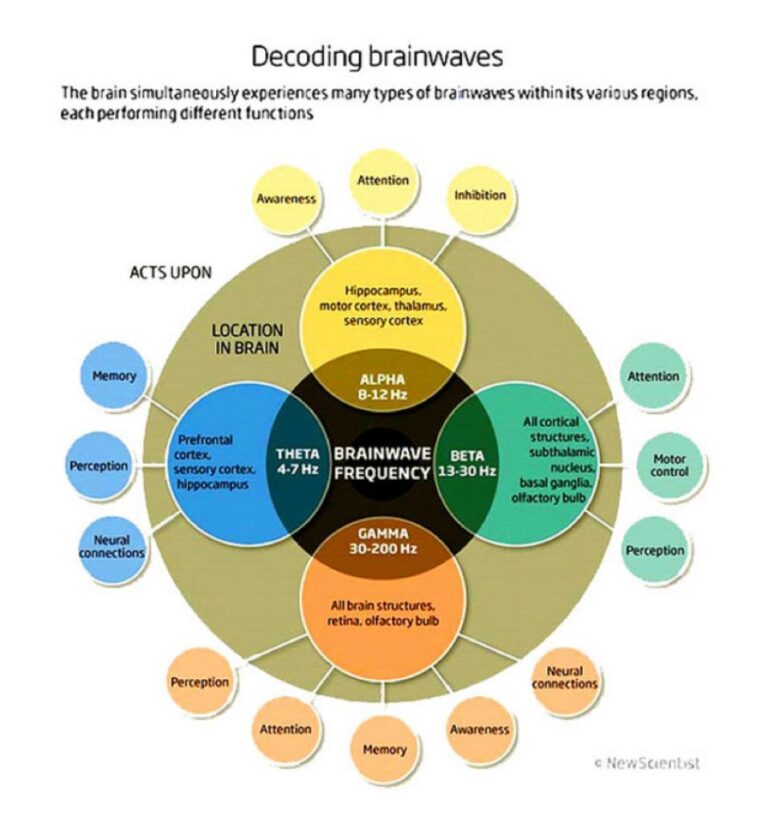
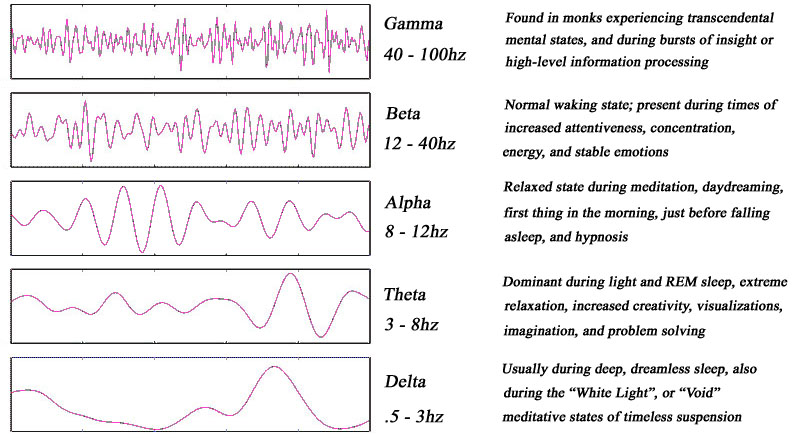
The five frequencies that our brain waves operate on are: Gamma, Beta, Alpha, Theta, and Delta.

From Highest to Lowest:
- Gamma waves are involved in higher processing tasks. Gamma brainwaves are usually very weak in normal people but have recently been found to be very strong in Tibetan monks while doing a Loving Kindness meditation. 40hz becomes the dominant frequency of these monks while meditating and it is also the frequency that the core of Earth resonates to. A very important frequency when it comes to higher awareness and mystical experiences. They are important for learning, perception, memory, and information processing. Individuals who have learning disabilities tend to have lower Gamma activity than average.
Frequency range: 40 Hz to 100 Hz (Highest)
Optimal: Binding senses, cognition, information processing, learning, perception, REM sleep
Too much: Stress, Anxiety, high arousal
Too little: ADHD, learning disabilities, depression
- Beta waves are fast brain waves which occur during active thinking activities, such as problem solving, focusing on tasks, and when we are alert and engaged with our environment. They are involved in conscious thought, logical thinking, and tend to have a stimulating effect. Having the right amount of Beta waves allows us to focus and complete school or work-based tasks easily. However, too much Beta may lead to us experiencing excessive stress and/or anxiety like those who overwork and never give themselves time to rest or relax. The higher beta frequencies are associated with high levels of arousal. Beta has 3 categories:
Frequency range: 12 Hz to 40 Hz (High)
- Hi-Beta (20.5-28 Hz) – Hi-Beta waves are seen during highly complex, rapid thought including states of excitement and high anxiety.
- Beta (16.5-20 Hz) – Beta waves are the intense, focused brain activity when we are working on solving a problem or actively engaging with our environment.
- Lo-Beta (12-16 Hz) – Also known as sensorimotor rhythm (or SMR), the Lo-Beta waves have been shown to be very beneficial in reducing anxiety, increasing focus and overall wellbeing and health.
Optimal: Conscious focus, memory, problem solving
Too much: Adrenaline, anxiety, high arousal, inability to relax, stress
Too little: ADHD, daydreaming, depression, poor cognition
- Alpha waves bridges the gap between our conscious thinking and our subconscious mind. It helps us calm down to meditate, and promotes feelings of deep relaxation. This is good for working on creative projects. However, if we become stressed, a phenomenon called “Alpha blocking” may occur which involves excessive beta activity and very little alpha. Many people access this wave state through daily meditation especially from using the “Primal Ohm” meditation.
Frequency range: 8 Hz to 12 Hz (Moderate)
Optimal: Relaxation,Meditation, Creativity, Yoga
Too much: Daydreaming, inability to focus, too relaxed
Too little: Anxiety, high stress, insomnia, OCD
- Theta waves Theta helps improve intuition, creativity, and is also involved in restorative sleep. It is the first state we enter when falling asleep “dozing off” and when awakening in the morning. It is associated with a state of somnolence and reduced consciousness to a hypnotic state. This is the state a hypnotist works with when using hypnotherapy for healing traumas and destructive patterns. Theta waves are responsible for us experiencing deep and sometimes raw emotions. Children below age 7 years old have been found often in Theta states. For older people, too much Theta activity may make people prone to bouts of depression and may make them “highly suggestible.”
Frequency range: 4 Hz to 8 Hz (Slow)
Optimal: Imagination, visualization, emotional connection, intuition, emotional healing, relaxation
Too little: Anxiety, stress, poor emotional awareness
- Delta waves are the slowest human brain waves found most often in infants and some younger children. As we age, we tend to produce less. Delta waves are associated with the deepest levels of relaxation and restorative, healing sleep and unconscious bodily functions such as regulating heartbeat and digestion.
Frequency range: 0 Hz to 4 Hz (Slowest)
Optimal: natural healing, lucid dreaming, restorative sleep, immune building and DNA repair.
Too little: Inability to rejuvenate body, inability to revitalize the brain, poor sleep
Why listen to Binaural Beats?
Listening to binaural beats daily can work wonders for you. You are basically adjusting the frequency of your brain to optimize your performance for various tasks performed throughout the day. These are mainly to assist with priorities and things that mean the most. These tasks include, working on creative projects, assisting with focus at work or problem solving, assisting with meditation and visualization, as well as to facilitate deep relaxation and sleep after a long day. Most of us are operating in a state of conscious alertness most of the time, so retraining our brains and bodies to take a break, and relax sometimes is key to good health and longevity.
Binaural beats change the frequency of our brain to different states. You can also amazingly use them when planting affirmations into your subconscious to reprogram and eliminate habits that don’t serve you. Using the right binaural beat for assistance requires activating the correct brain state. These states are called Gamma, Beta, Alpha, Theta, and Delta.
Using Binaural Beats
Each cycle is relevant for different levels of consciousness. Our brains cycle at least once through each brainwave listed above, sometimes multiple times throughout the day. The goal is to binaural beats to transform an unhealthy, dysregulated brainwave imbalance into a normal, healthy, organized pattern. By doing this, the brain becomes more stable and is able to operate optimally and efficiently.
Brain waves can be divided into different speeds (fast, medium or slow) and correspond to different types of thought patterns. They are often compared to musical notes, since each type of brain wave has its own “sound” which is distinct from others. When the brain is working well, it is like a symphony in harmony, with the different brain waves occurring in predictable patterns and using fluid jumps between mental states. However, in certain individuals, the brain wave patterns can be irregular and one type of brainwave can dominate too frequently or at the wrong time.
If our brains were constantly operating in a state of Beta (alert) we wouldn’t allow our bodies time to relax. Our brainwaves are constantly changing, so you might wake up in a drowsy state from your dreams which would be Theta or Alpha state. But as soon as you started thinking about what you have to do that day, you’d end up in the Beta state. After getting ready for work, you might get onto the highway and “zone out”. The “zoning out” is called “highway hypnosis” (or white line fever) and you might have dipped back into the Alpha brainwave state which is where the “subconscious” resides or the unconscious state. This happens everytime we daydream, reminisce, or listen to music.
Once you get to work, there might be challenging projects you have to work on. When you have to really use your brain for more difficult problem-solving tasks you might enter the Gamma state. Once you get back from work you become more relaxed and may go from the Beta state into the Alpha state. If you went home and switched on the TV, you would likely switch to Alpha within a minute of watching the narrative of the show or movie. Again, if you meditated before bed you might slip into the Alpha, Theta, or Delta state depending on your starting level of relaxation. When you sleep your brain doesn’t just stop processing; it actually starts to process more. You may end in REM sleep and start dreaming, which would be the Gamma state. When you become lucid in a dream you may end up in the Gamma state. Some researchers found lucid dreamers as high as 40 Hz. Using Binaural beats can help you easily jump from cycle to cycle or to a particular chosen cycle needed for a task.

Again, the overall goal is to transform an unhealthy imbalanced brainwave into a normal, healthy, organized pattern. By listening to binaural beats, the brain becomes more stable and is able to operate optimally and efficiently.
How Do Binaural Beats Work?
A binaural beat (or binaural tone) is an auditory illusion that occurs when you are listening with headphones to two different pure tone sine waves, both with frequencies lower than 1500 Hz, with less than a 40 Hz difference between them. ³ This effect was discovered in 1839 by Heinrich Wilhelm Dove. The word binaural means “having or related to two ears”, the “bi” portion of the word is for two and the “aural” portion is related to ears. When two different tones, separated in frequency by only a few Hertz, are introduced — one in each ear — the brain perceives a third, unique tone – the binaural beat. Binaural beats work by creating this phantom frequency, which the brain then mimics.
If you hear the frequency of 240 Hz on one side, and 250 Hz on the other side through headphones, your brain makes up the difference of 10 Hz. This 10Hz falls into the Alpha brain wave state according to the chart above. If you take off one earbud, you’ll just hear a regular tone, and the same goes for the other side. But when you’re listening to both sides at once, your brain starts to make up that difference or create the unique tone -the binaural beat. To get the benefit you must listen to binaural beats with your headphones or earbuds.
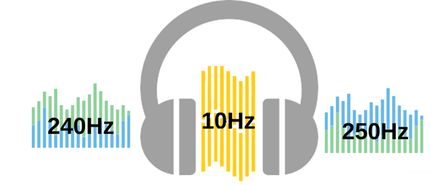
If you play the tones through a stereo rather than headphones the tones will mix, and you’ll hear the sound, but because you are hearing the sound, your brain doesn’t make up the difference.
Frequency Following Response
If it wasn’t for our brain’s “Frequency Following Response” (FFR) listening to binaural beats would just be an interesting listen. But once the brain starts to generate the difference between the two tones (the binaural beat), then your brain starts to mimic or follow the wave that you’ve selected to listen to. This is also called “Brainwave entrainment”.
So if you’re really stressed out and want to meditate, you can listen to binaural beats in the Alpha, Theta and/or Delta range. Some binaural beat tracks will take you through many different stages to ease you into a deeply relaxed state. Other people choose to listen to binaural beats in the Gamma state for working on assignments for work or school. Some use binaural beat tracks to get into lucid dreams while sleeping.
What Can Be Some Dangers of Binaural Beats?
Though the majority of people can engage in binaural beat therapy without any issues, those with neurological or cardiac issues should be cautious.
Seizures
If you’re prone to seizures, you should be wary or contact a healthcare professional concerning it. Be mindful that, if you were thinking about using binaural beat therapy for your children, they are more susceptible to seizures than adults.
Psychological Disorders
If you have a psychological disorder you may want to consult a healthcare provider first. Some people with bipolar disorder experienced problems and needed to stop using binaural beat therapy. The Theta brainwave has to do with feeling raw emotions, and that can be very therapeutic, but it can also be too much for someone who’s currently working on these issues even without the use of binaural beat therapy.
Pregnancy
It’s not recommended to use binaural beat therapy while pregnant. Children are more susceptible to seizures, and a baby’s heart could be affected from the change of frequencies going on in the mother’s body.
Irregular Heartbeats /Heart Disease
Changing your brainwaves can also affect your heart rhythm. If you have heart problems or wear a pacemaker, you should consult a healthcare professional before attempting binaural beat therapy.
Possible Side Effects with Drugs
It’s not recommended to take drugs that might negatively affect you at the same time as using binaural beat therapy as you don’t know what kind of side effects could occur and if you go into one of the more relaxed brainwave states you won’t be thinking as clearly if you need to deal with side effect issues.
Operating Heavy Machinery
Using binaural beat therapy to get into the lower states of consciousness lowers your ability to think clearly. You wouldn’t want to be as “out of it” as you are when you’re in a deep state of sleep and at the same time be driving on the road at 60 mph. Listening to frequencies lower than Beta is not recommended.
Headaches
Some people report getting headaches. It may be from the specific frequency used in that binaural beat track, so when you don’t have a headache on another day you can test out other tracks out with different frequencies. It may be because you’re having increased blood flow into the brain and causing a vascular headache. If it’s a matter of blood flow to the brain increasing it may go away after a few weeks. If you continue to notice headaches from it, then refrain from using binaural beat therapy.
Over Listening
People have discussed feeling the effects of binaural beats after they’ve listened to binaural beat tracks. One example would be listening to a track for lucid dreaming before going to bed, and then having a lucid dream that night. In the case of lucid dreaming you might think you need to listen to the track while asleep to become lucid, but in this case the person did not need to be listening at that exact moment. This shows that you don’t need to listen to the binaural beats continuously to keep feeling the effects. The possible effects are already outlined in the “Too Much” section of each brain wave cycle.
Those with ADD/ADHD have slower brain waves than that of the rest of the population. They produce slow Theta waves when they should be producing fast Beta waves. The ADD/ADHD person compensates for the increased Theta production with hyperactivity. During sleep, clients usually have combinations of the slower frequencies, but during deep REM (rapid-eye movement) sleep, more Gamma activity is present.
When using binaural beat therapy pay attention to how it affects you personally. When you listen to binaural beats, pay attention to see if you’re having symptoms of being in one state for too long, and take breaks if needed.
The recommended listening time is up to 90 minutes, once a day or every other day. But pay attention to how you react to it and use it less or stop 0completely if you experience any negative effects. Again, the benefit of listening to binaural beats is to help the brain become more stable and able to operate optimally and efficiently.
Download your binaural beat meditation here!
Other notable frequencies:
What is the Schumann Resonance: 7.86Hz-8Hz.
It is said that 8Hz is the fundamental “beat” of the planet. The heartbeat of the Earth is better known as Schumann resonance and is named after physicist Winfried Otto Schumann, who documented it mathematically in 1952. Schumann Resonance is a global electromagnetic resonance, which has its origin in electrical discharges of lightning within the cavity existing between the Earth’s surface and the ionosphere. This cavity resonates with electromagnetic waves in the extremely low frequencies of approximately 7.86Hz – 8Hz.
The “ordinary” thought waves created by the human brain range from 14Hz to 40Hz. This range only includes certain types of dendrites belonging to brain cells, predominantly within the left (the more rational) hemisphere of the brain, which is the center of activity.
If the two hemispheres of our brain are synchronized with each other at 8Hz, they work more harmoniously and with a maximum flow of information. In other words, the frequency of 8Hz seems to be the key to the full and sovereign activation potential of our brain. For example using a binaural beat of 20Hz in the left ear and one of 12Hz in the right ear. The brain will create a third one beat at 8Hz which syncs with the frequency of the natural earth’s surface. 1
4
8Hz is also the frequency of the double helix in DNA replication. Melatonin and Pinoline work on the DNA, inducing an 8Hz signal to enable mitosis and DNA replication. A form of body temperature superconductivity is evident in this process.
What does 8Hz has to do with 432Hz tuning
432Hz resonates with the frequency of 8Hz. If we take 8Hz as our starting point and work upwards by five octaves (i.e. by the seven notes in the scale five times), we reach a frequency of 256Hz in whose scale the note A has a frequency of 432Hz. On a scale where note A is 440Hz, the C note is 261.656 Hz. Many dispute this music pitch to be unnatural or out of natural balance rhythm.
According to the harmonic principle by which any produced sound automatically resonates all the other multiples of that frequency, when we play C at 256 Hz, the C of all other octaves also begins to vibrate in “sympathy” and so, naturally, the frequency of 8Hz is also sounded. This is why (together with many other mathematical reasons) the musical pitch tuned to 432 oscillations per second is known as the “scientific tuning.” This tuning was unanimously approved at the Congress of Italian musicians in 1881 and recommended by the physicists Joseph Sauveur and Felix Savart as well as by the Italian scientist Bartolomeo Grassi Landi. In contrast, the frequency chosen in London in 1953, 440 Hz as the worldwide reference frequency and which all music today has been tuned to, has come to be defined as ‘disharmonic’ because it has no scientific relationship to the physical laws that govern our universe.

There is Natural healing with 432Hz as the vibrational frequency found in all things throughout nature or the basic sound of the universe. This is the frequency of the “Primordial Ohm” or “Om chant” during meditation (symbol) above. According to the above information, playing and listening to music that has been tuned to 432Hz would make your body, and the organic world which surrounds it, resonate in a natural way. This would fill you with a sense of peace and well-being, regardless of the kind of song chosen to play or listen to. Listening to 432Hz music resonates inside your body, releases emotional blockages, and expands consciousness. 432Hz music allows you to tune into the knowledge of the universe around us in a more intuitive way. Other beneficial vibrational frequencies include the ones known as the Solfeggio Frequencies.
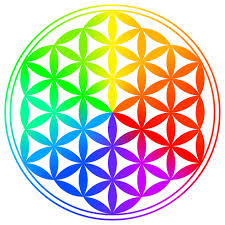
What are Solfeggio Frequencies and why Do We Use them?
Solfeggio frequencies are special tracks that help your brain waves achieve a frequency that has many benefits. Solfeggio Frequencies are typically used for transformational purposes and can help improve relationships, deal with fear and change, awaken one’s intuition, and so on. These Solfeggio Frequencies include a set of sacred numbers with a repeating sequence of 3, 6 and 9, and each Solfeggio Frequency has a specific purpose. They make up the ancient 6-tone scale thought to have been used in sacred music, including the beautiful and well known Gregorian Chants.
These tones contain the frequency required to balance your energy and heal you. For example, the 528 hertz (Hz) frequency can be used to repair DNA and is a frequency of Universal miracles. Solfeggio Frequencies are used in the meditative Soundscapes of many cultures along with sound bowls. Each Solfeggio tone is composed of a frequency required to balance your energy and keep your body, mind and spirit in perfect harmony.
The main six Solfeggio frequencies are:
(UT / Do) – 396 Hz – Liberating Guilt and Fear – 9
(RE) – 417 Hz – Undoing Situations and Facilitating Change – 3
(MI) – 528 Hz – Transformation and Miracles (DNA Repair) – 6
(FA) – 639 Hz – Connecting/Relationships – 9
(Sol) – 741 Hz – Expression/Solutions – 3
(LA) – 852 Hz – Returning to Spiritual Order – 6
528 Hz is by far the best known of the frequencies and features due to its regenerative and healing energy.
*Shown on the right of each are the single digit numbers the tones’ digits add to using the Pythagorean skein. (I.e. for 528, 5 + 2 + 8 = 15; 1 + 5 = 6.) Nikola Tesla said: “If you only knew the magnificence of the 3, 6 and 9, then you would have a key to the universe.” Whether he was speaking about electromagnetism or sound waves is irrelevant.
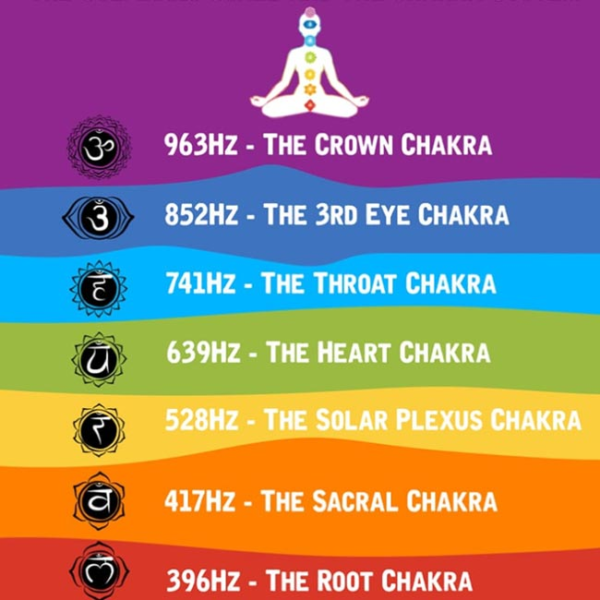
There is no specific order to listen to the solfeggio tones to get the full benefit nor is there a specific amount of time required. You can easily listen to the music while meditating, exercising, studying or even washing dishes. People report receiving benefits during and after listening to their tracks. Download your tracks today! Click here
Isochronic Tones
Listening to binaural beats daily can work wonders for you. You are basically adjusting the frequency of your brain to optimize your performance for various tasks performed throughout the day. These are mainly to assist with priorities and things that mean the most. These tasks include, working on creative projects, assisting with focus at work or problem solving, assisting with meditation and visualization, as well as to facilitate deep relaxation and sleep after a long day. Most of us are operating in a state of conscious alertness most of the time, so retraining our brains and bodies to take a break, and relax sometimes is key to good health and longevity.
Binaural beats change the frequency of our brain to different states. You can also amazingly use them when planting affirmations into your subconscious to reprogram and eliminate habits that don’t serve you. Using the right binaural beat for assistance requires activating the correct brain state. These states are called Gamma, Beta, Alpha, Theta, and Delta.
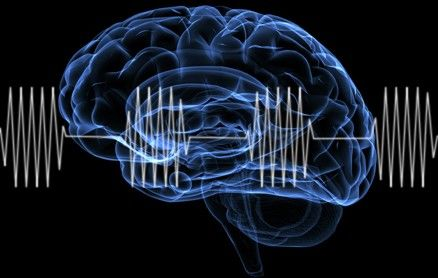
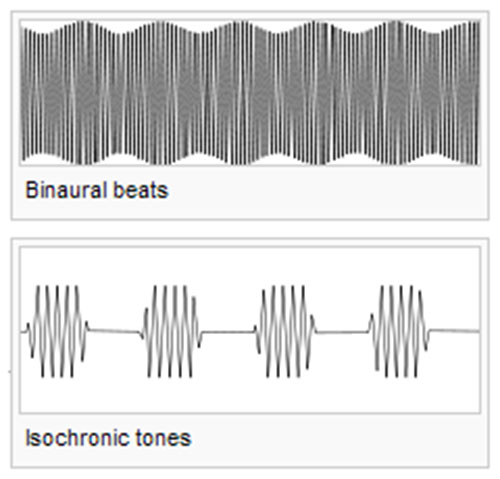
Isochronic tones are tones that have a pulsating sound. This is because the tone is being turned on and off rapidly, which creates a pulsing effect. This creates a sharp, distinctive pulse of sound, much like an alarm clock with an equal beeps. With isochronic tones, the stimulus is in the form of a clear and repetitive beat/tone. The speed at which the tone is switched on and off is measured in terms of Hertz (Hz) according to the brainwave cycles just as binaural beats. Isochronic tones do not require wearing headphones and can be played on a stereo, perhaps enabling more movement. The speed of the tones turning on and off depends on the frequency playing. So for a low frequency the tone pulsates slow, and for a high frequency the tone pulsates fast. Isochronic tones excite the thalamus, encouraging the brain to follow along to the frequency of the tones.
For isochronic tones you need to be fairly close to the speakers, as the entrainment diminishes the further away from the speakers you get. The main concept behind isochronic tones and brainwave entrainment methods, in general, is the ability to change your dominant brainwave frequency and guide your brain to a preferred or optimum mental state.

The distinct and repetitive beat of isochronic tones produce what’s known as an evoked response in the brain. This is an electrical potential recorded from the nervous system, following the presentation of a stimulus. The process of brainwave entrainment relies on the natural phenomena of synchronization. Entrainment is defined as a ‘synchronization of two or more rhythmic cycles’ and you may already have seen or experienced it yourself, without knowing what was going on.
Here a few examples of natural synchronization:
Flashing Traffic Lights/Hazard lights – Many times we have been driving then come to a stand still where we see flashing lights on a sign or hazard lights pulsating a color. As we sit our brains become stimulated by the rhythm and synchronize with the frequency
Fireflies – If you witness fireflies in action at night, you will notice that as the night wears on they will start to flash in unison.
Tuning forks – When you strike a tuning fork and then place another one next to it, the second tuning fork will automatically start to vibrate at the same frequency.
Pendulum clocks and metronomes – If you placed a number of pendulum clocks or metronomes in close proximity to each other, and set them all off swinging at different times, within a few minutes they will all start to swing together in unison.
Frequency Following Response
When brain waves become entrained and synchronized with the same frequency of an isochronic beat, this is known as frequency following response (FFR). The frequency of the stimulus/beats can then be changed and your dominant brainwave frequency follows along in step with it.
By using the power of FFR, your brainwave activity can be guided to a more optimum frequency, to enhance or improve your mental states.
For example, when you are very stressed or anxious, your brain will usually be producing an elevated amount of the higher beta brainwave activity. By stimulating your brain with lower alpha frequencies you can reduce the frequency of your dominant brainwave activity, helping to calm your mind and reduce the feeling of stress.
Download your isochronic meditation here!
Here a few examples of natural synchronization:
Flashing Traffic Lights/Hazard lights – Many times we have been driving then come to a stand still where we see flashing lights on a sign or hazard lights pulsating a color. As we sit our brains become stimulated by the rhythm and synchronize with the frequency
Fireflies – If you witness fireflies in action at night, you will notice that as the night wears on they will start to flash in unison.
Tuning forks – When you strike a tuning fork and then place another one next to it, the second tuning fork will automatically start to vibrate at the same frequency.
Pendulum clocks and metronomes – If you placed a number of pendulum clocks or metronomes in close proximity to each other, and set them all off swinging at different times, within a few minutes they will all start to swing together in unison.
Binaural beats were discovered in 1839 by Heinrich Wilhelm Dove which is longer than isochronic tones so it has more research backing it. However, the first Isochronic tones study was published by Arturo Manns in 1981, which showed that isochronic tones produce a much stronger brainwave entrainment effect, compared to binaural beats. The feedback so far on isochronic tones have been extremely positive. People tend to agree that isochronic tones work, and some people prefer them simply for the way they sound and the ease of being able to play them on speakers. Isochronic tones only use one tone, whereas binaural beats use two. The singular tone is spaced and turns on and off in a pattern. Some find the time intervals between tones to be a little bit jolting, while others feel it is this element that makes isochronic tones to be the fast-acting and effective technology that it is.
As for the actual effectiveness of the technology, there is no conclusive evidence stating that one is more effective than the other. However, numerous case studies have shown that many people prefer isochronic tones for enhancing IQ and concentration, which is created by stimulating the higher brainwave frequencies such as beta and gamma, while more people tend to prefer binaural beats for meditation and relaxation, or the lower frequencies such as alpha, theta, and delta. Some find the isochronic tones to be a little bit sharper and more conducive to alert states, while binaural beats are more soothing. This is just speculative at the moment, many people simply prefer one technique over the other for personal reasons. Both technologies have proven to be effective at creating a hypnotic state within the whole spectrum of brainwave states. The only way to determine which one is better is to try them out and see which one works best for you.
Binaural Beats and Isochronic tones wave charts below